- You're the Balm
- Posts
- 🐉 Good grief, you're not a downer
🐉 Good grief, you're not a downer

Karen Choi
February 01, 2026
At the risk of sounding melodramatic, “There’s a grief that can’t be spoken. There’s a pain goes on and on.”
(My musical theatre buddies will recognize these words from Les Misérables.)
I find myself quietly singing these words followed by deep sighs. Music, art, poetry, nature, a hot cup of tea, moving gently, and loving on my people are the only things that seem to make sense these days.
Knowing what’s happening in the world, why would I even think it’s over the top?! When did grief become something we hush at? When did the human response to loss become taboo in Western culture? When did it become something we hide?
When grief became “too much”
Since most of us are in Canada, I’ll refer to the Victorian era before the World Wars, when mourning was a very public, visual, and highly structured activity. People wore formal black for months or even years. Funerals were long and elaborate. Communities gathered around gravesites. Grief had a visible place to live.
But the massive loss of life in World War I and II, broke that system. Over 100 million deaths (military and civilian). Too many bodies. Too many missing. Too many grieving.
So society quietly decided that grief had become untenable and impossible to continue. Not deemed wrong or unnecessary, but just…too much.
Put on a brave face and get over the loss as quickly as possible. Business had to continue as usual. Women had to work. Nations had to stay strong. Stoic silence was encouraged to show strength and support for the war effort. Anything else was seen as unpatriotic. A burden. So grief stayed behind closed doors.
By the 1960s, open expressions and discussions of grief were seen as “a morbid self-indulgence”. Historians termed this era the “Forbidden Death” where dying became shameful and hidden. Open sadness was a sign of weakness or mental instability. Grief became a condition to be cured or quickly managed, rather than a natural, long-term process.
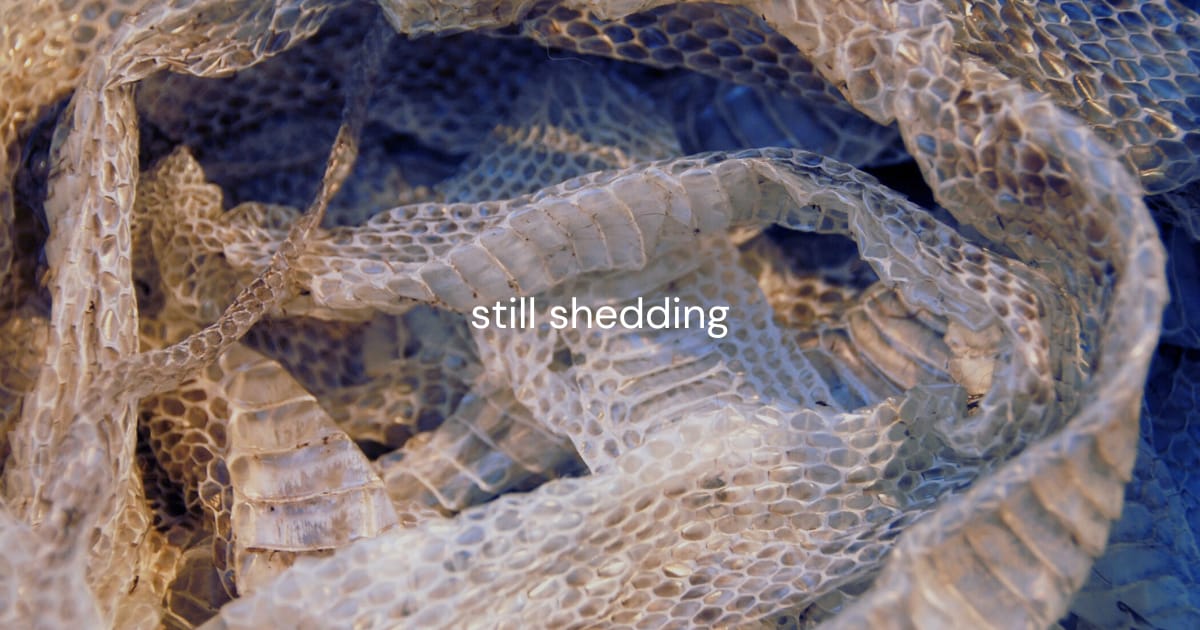
Grief didn’t disappear. It was packed in a box and tucked away in the back of the closet. Private, internal, silent. And we never came back from that. It’s as if we drywalled over that closet door, then papered over it with messages of happiness and productivity.
Except, our hearts, minds, bodies, and souls are that closet. The wallpaper — the masks we wear — is peeling.
Grief changes shape, but it never ends.
The grief I know
Over the past six years, I’ve made space for different forms of grief. Some chosen, some unexpected.
Some of it was my own. A series of foundational floors fell out from beneath my feet. The deep, identity-shifting kind. Leaps of faith in my career. Disillusionment with the religion I was raised in. Relationships revealing truths that forced me to see myself and others more clearly.
Some of it was final. When someone in the immediate family dies, it’s not just one gone. Everyone affected by that loss changes too. The death of my husband’s father was also my mother-in-law’s husband, my two daughters’ grandfather, and my father-in-law.
Some of it lives with us. When my mother-in-law moved in, she brought not just her belongings, but also her grief. The heartbreak of losing her favourite person in the whole world and all their dreams of the present and future is always with us.
Some of it witnessed. A friend who packed up her city apartment to move to the suburbs and take care of her aging parents. A friend going through divorce. A friend caring for a parent after another parent passed away. A client who said goodbye to a long-term relationship and home. A client who left a career and community they loved. A client who cared for their husband through cancer and death.
Some of it is collective. Ongoing horrible events, global suffering, chaos and confusion. I cannot even.
This incomplete list of words barely express the magnitude of the human experience. We’re all grieving.
If you’re still reading, I imagine you’re one of the real ones who’s lived (and living) through some things and is brave enough to sit with it. I’m grateful we’re here together.
I know that this feels quite the opposite of uplifting, but our experiences are worth lifting up, so they don’t drag us down. And in the spirit of Balm, I do this with music, poetry, and movement.
🎶 One Song
This piece of music stopped me in my tracks a couple years ago when I watched a video clip of Daniel performing it at a music festival. I can’t tell you how many times I’ve let these 7 minutes just hold me.
🪶 One Poem
Token Loss
To the dragon
any loss is
total. His rest
is disrupted
if a single
jewel encrusted
goblet has
been stolen.
The circle
of himself
in the nest
of his gold
has been
broken. No
loss is token.
The dragon lives in all of us. Give the dragon some grace. 🐉
〰️ One Move
Twelve Rivers Flow is inspired by Qi Gong and the ancient understanding of the body as a living network of 12 meridians (aka inner rivers) linked to the major organs. This slow, circular movement invites breath and awareness to travel through the whole body. Gently encouraging circulation and spaciousness to restore the nervous system.
Step by step:
Inhale for 4 — Gather: Draw open palms in toward your heart, elbows soft and bent.
Exhale for 4 — Press: Press the air forward with your palms until your arms lengthen.
Inhale for 4 — Expand: Open your arms wide to the sides at shoulder height.
Exhale for 4 — Rise: Sweep arms overhead, palms up, and lift onto your toes.
Inhale for 4 — Pour: Bring fingertips to thumbs, then tip the hands downward as if pouring.
Exhale for 8 — Feather down: Lower your arms slowly like wings, and let your heels melt back down.
Repeat + Close: Repeat until it feels like “enough”…then do one more.
May we learn to carry one another when words fall short.
May we make room for grief, without fear or hurry.
May we remember that love and loss live side by side.
And may we walk gently with ourselves and each other.
With love,
Karen
P.S. This reflection is the heart of Soul Care Sunday on February 8. If this newsletter resonated, I’d love to hold space for you — in person and in community.
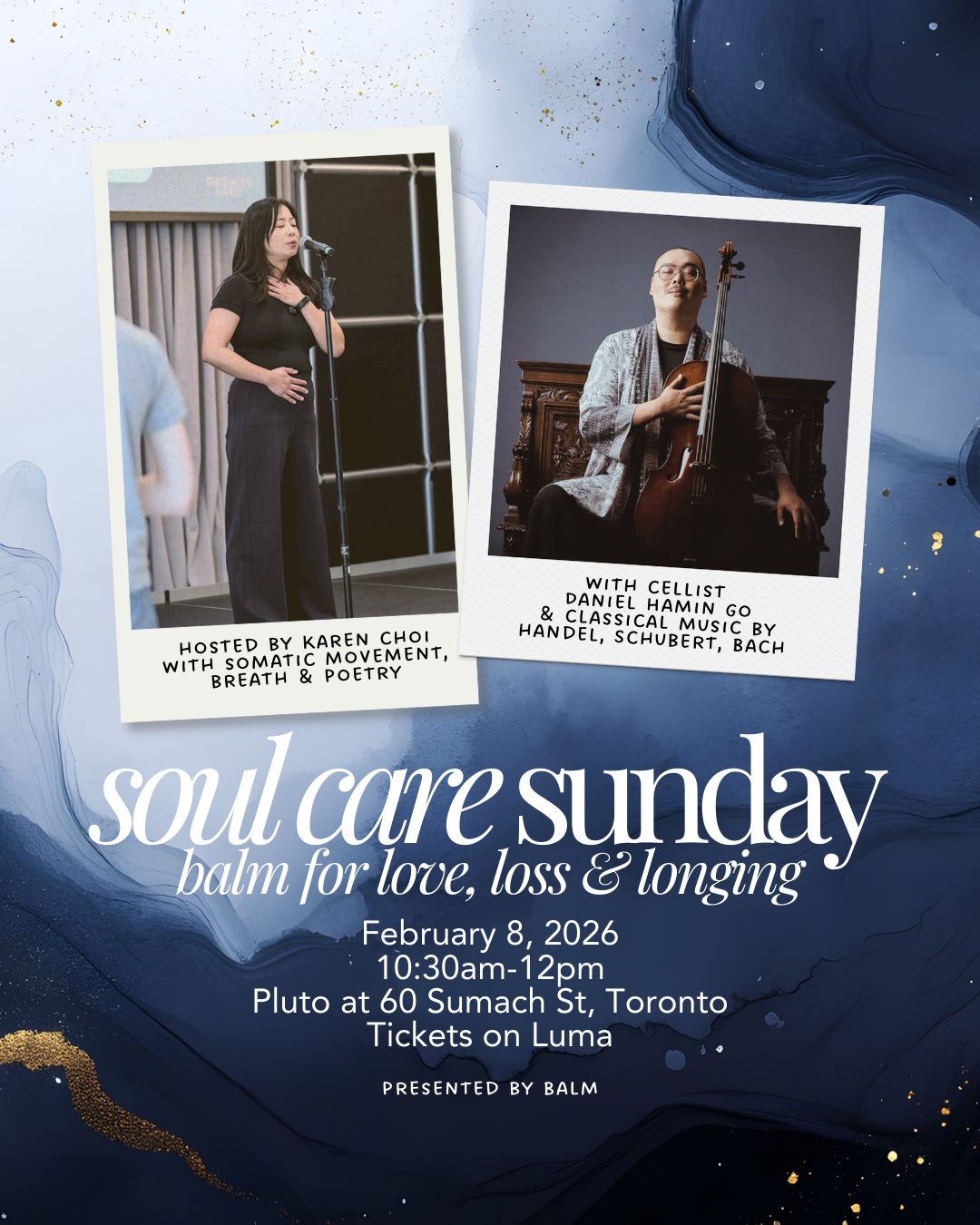
P.P.S. We want to share Balm’s restorative music experiences with as many people as possible. If you’d like to bring this work to your community, workplace, or event, I’d love to hear from you. I talk more about this aspect of the work on LinkedIn — happy to connect there too.
#20
Reply